

ACADEMY / Strategy generation
Strategy Generator Software Compared: What to Check Before You Choose
Strategy generators differ in how they search, how they validate, where they export and how they are licensed. Here are the questions to ask before you choose, and how to check the answers yourself.
By Soren Huang · Published · updated · Editorial policy
The questions that matter
A generator is one route into algo trading, and the other is writing the rules yourself in Python.
Strategy generators can look alike at first glance. The differences that affect your research are more specific:
- Where will you trade? Export to your platform is not optional. Check the exact platforms and languages, whether export is built in or needs an extra step, and whether the exported code is readable and editable.
- How does it validate? Look for walk-forward analysis, out-of-sample testing and Monte Carlo methods, and whether they are included in the edition you would buy.
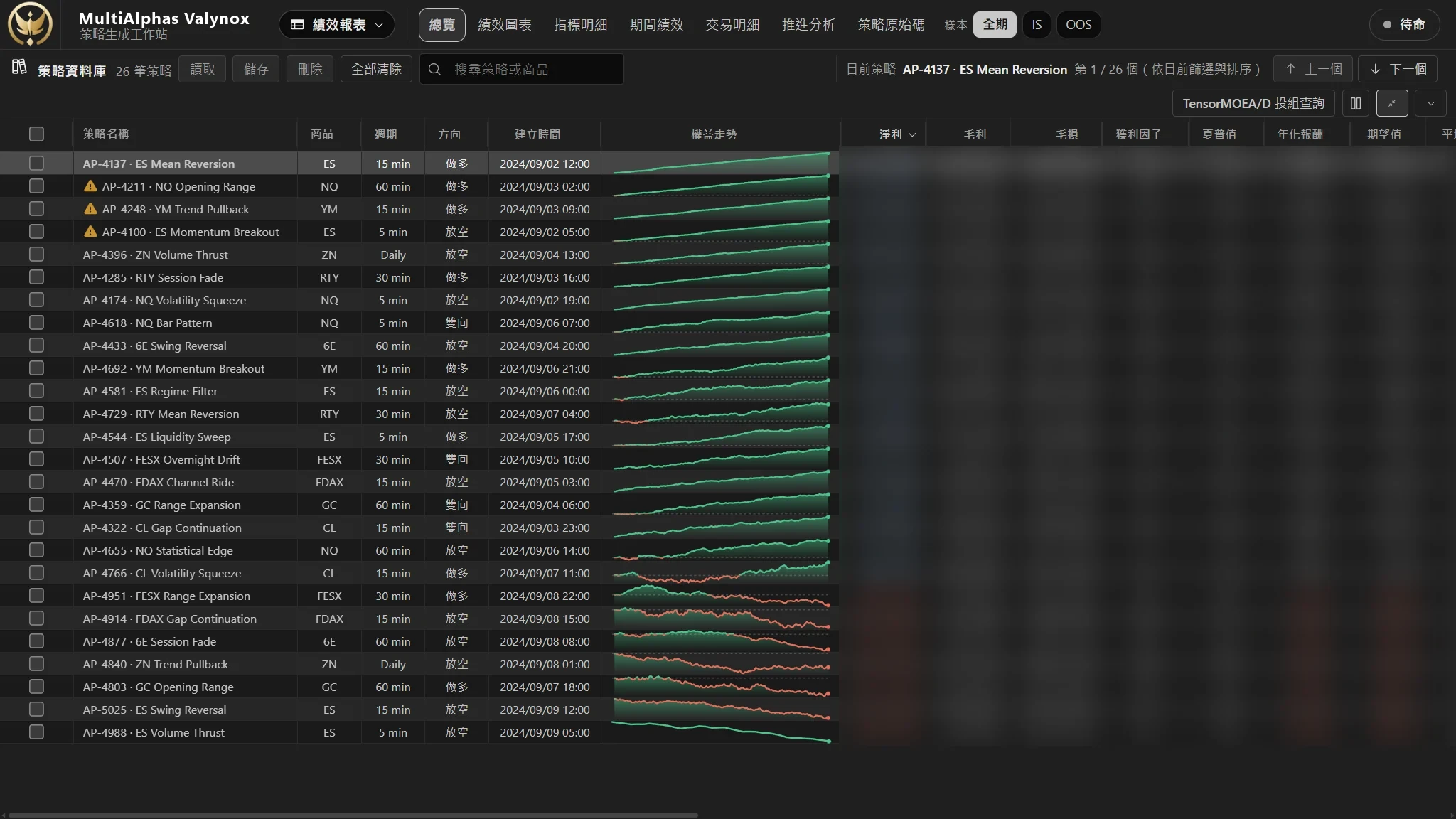
- Does it model costs during the search? Commission, slippage and execution timing should shape the ranking from the first run, not be subtracted at the end. In the backtesting of MultiAlphas (Valynox), fees, slippage and next-bar execution reach every candidate during the search. The guide to trading costs in backtests shows why.
- How does it compute? CPU cores, multiple machines or GPU. This decides how large a search, and how much validation, you can run in a working day. See GPU vs CPU backtesting.
- What does it run on? Operating system, and hardware requirements such as a specific graphics card.
- How is it licensed? One-time or subscription, how many computers, what happens to updates, and whether you can upgrade later without paying twice.
- Can you try it first? A trial, demo or recorded walkthrough, and what the trial leaves out.
How to read a vendor's answers
- Use the official site, and note the date. Prices, editions and features change. Write down where and when you read each answer.
- "Not stated" is not "missing". If a feature is not on the site, ask the vendor before you count it against the product.
- Check the edition, not the product. Some tools include certain validation methods or export targets only in higher editions.
- Read speed claims carefully. A number means little without the hardware, the data length and what counts as one strategy. See how to read a speed claim.
Before you decide
- Run the same test in every tool you are considering: same market, same data range, same costs. Compare the trade lists, not only the summary statistics.
- Check what the edition you would buy includes.
- Check that exported strategies reproduce in your trading platform. See the comparison checklist.